Poems, Imitations & Translations

Showing posts with label 2009. Show all posts

Tuesday

Pale Star (2011)


Pale Star (2011)

(January 18, 2011) Pale Star. Illustrated by Bronwyn Lloyd (Auckland: Pania Press, 2011)


Pale Star
(K.M., 1923) [after Xu Zhimo] Unintentionally imitating Chinese style her hair was pitch black & straight Her features seemed to me like the purest Indian jade or pristine snow in the Alps Her brightly-coloured clothes might have aroused some criticism had they been worn by anyone else on her they looked becoming like green leaves on a flower Her figure was so fragile that a man standing beside her felt his breathing to be too coarse (7/4-24/7/09)


KM & Xu Zhimo. Pania Press (18/1/11)


Poets at Seven Years Old (2009)


Bronwyn Lloyd: Rimbaud in Flannel (2009)

(May 27, 2009) Bronwyn Lloyd: "Rimbaud in Flannel." Mosehouse Studio (27/5/2009)

Poets at Seven Years Old

Shutting her pious book, the Mother rose
and kissed her little boy … what mother sees
in Angel-face, his big eyes free of guile,
bile and disgust tormenting the nude soul?

All day long he sweated to obey;
clever, quick, yet something seemed to say
– little habits, tics – that this was sham.
Alone in mildewed corridors, he would scream
shit-fuck! clench his fists, stick out his tongue, 
screw up his eyes into a blood-red sun.
A door opened on darkness – the backstairs,
the one place he could lie and gasp for air
in the dome of day a lamp hung from the night.
Burnt stupid by blank waves of summer heat
he hid himself inside the dank latrines;
there he could breathe – sniff something that was clean.

In winter, when the moon washed their back yard
with icy candour, he would creep out and hide
by the stream that ran inside their boundary wall;
trying to see by knuckling at his eyeballs,
he heard the pine-trees groan like ships at sea.
Although he felt some sneaking sympathy
for those trespassing kids who dropped their eyes
at his approach (stink-fingers black and creased
with yellow clay from damming up the creek),
they turned from him like dolts and would not speak.

And if his mother caught him at this game
and told him off, the fact he looked ashamed
fooled her into forgiveness.  He was shy.
Those lips were always ready with a lie.

At seven he made up Westerns: wild romances
set in the desert – where freedom reigns (and Dances
with Wolves?); sunsets, rivers, cliffs, savannahs …
Staring at naked woodcut señoritas
till he turned red, he dreamt of foreign girls.
So when that saucy eight-year-old, her curls
bobbing, thin cotton dresses … like a squaw
with soft brown eyes … came over from next door
and jumped him – little beast – pulling his hair,
caught underneath, he bit her on the bare
bum (“wild women never put on drawers!”);
then, scratched and beaten by her fists and claws,
he carried the scent of her back to his room.

Most of all, he feared Sundays at home,
brushed clean and collared, sitting with his back straight,
reading about a God he’d learnt to hate
in a mould-green Bible with a faded back;
the nightmares came as soon as it got dark.
He loved to watch those swart, roughly-dressed men
straggle home from work in the red evening
ready for the distractions of the streets
– his dreams were of wide prairies of ripe wheat:
gold thistledown, rich scents, in the calm light
of noon, till rough winds swept them out of sight.

He fixated most on things that were dark and old –
sitting in a cold blue room with the blinds pulled,
damp dripping off the walls, mouthing the words
of a story he could see inside his head
full of drowned forests; leaden, ochre skies;
flesh-haunted flowers; starry immensities;
despair; retreat; stiff salmon-leaps; and pity!
Engulfed by the vast engine-grinding city –
lying in the creased haven of his bed,
he bent his sails where a blind future led …

(7/91-18/5/97)


Such a great poem! As you can see it's loaded with imagery with great pop-up potential.

I've started on the first flannel board spread for the textile book. I took advantage of the sale at the Warehouse last weekend and stocked up on striped and floral flannel pyjamas and sheets to cover the backing boards. What you see here is part of the first stanza, but I'm about to weird it up by adding lots of tendrils coming from the boy's bed, which will be connected to his nude poetic soul, who will be crawling away over the opposite wall and into the next spread.

I just have to work out what the inner poet of a seven year old boy might look like ...

- Bronwyn Lloyd (21/3/2026)


Monday

Silhouette (2009)


Silhouette (2009)

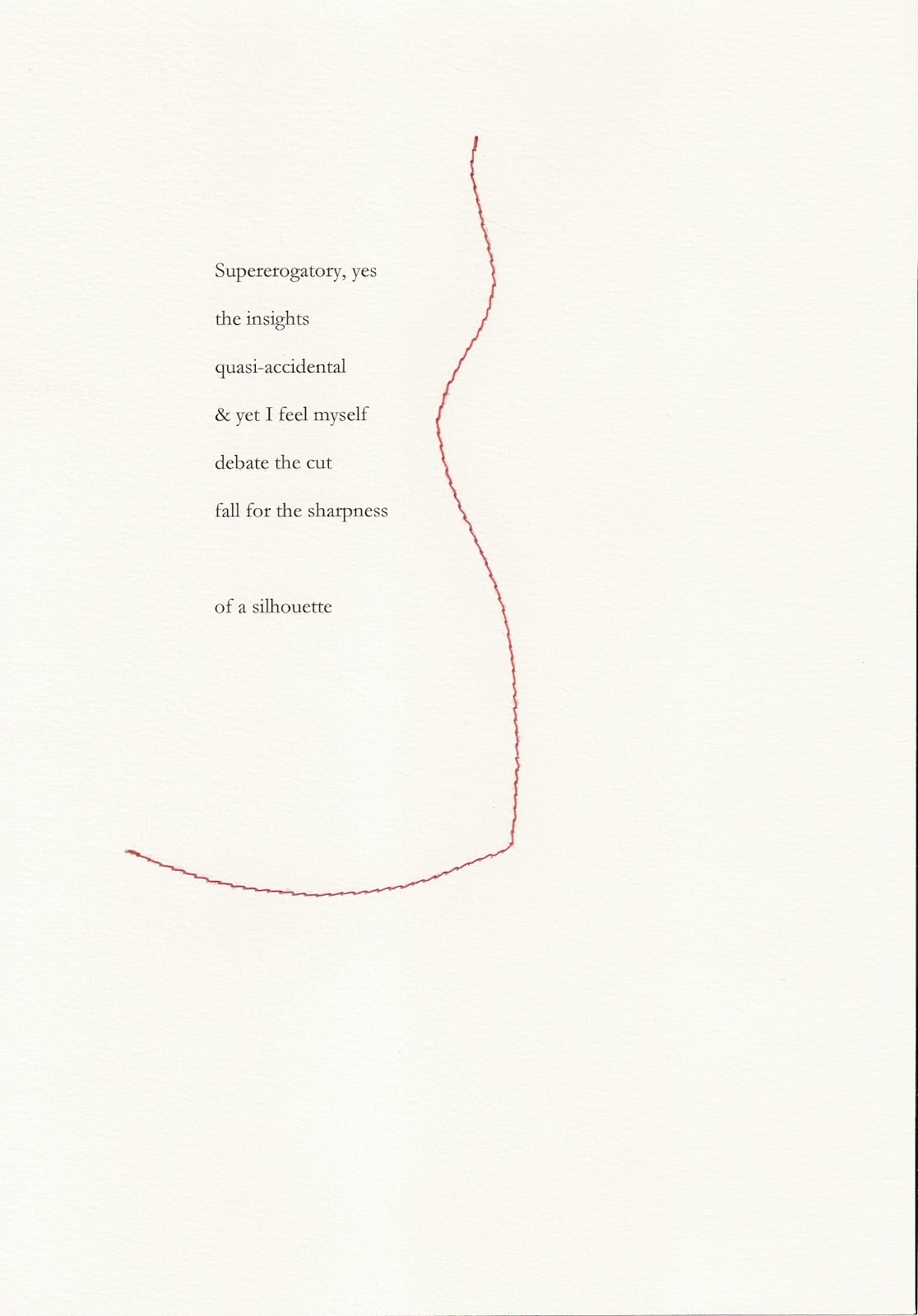
  • (December 25, 2009) Silhouette. Auckland: Pania Press, 2009.


  • Silhouette
    Is form your master or your slave? Diane von Furstenberg’s aesthetic: Lots of layers, flowy, elegant Marlene Dietrich in A Foreign Affair a spy, a glamour girl Berlin, Shanghai … I set the video rolling on longplay halfway through the night before it nets up everything for those six hours Project Runway included our Saturday morning ritual over toast & jam My taste is impeccable Daniel’s pompous declaration earned him a braying laugh last week from poster-girl Kenley This time her skimpy dress is “simply not enough” to net the prize No-one can layer prints like you do Tim flatters Diane accepts the tribute as her due The designers wet themselves with glee to serve such a big name Is form your master or your slave? I am an artist on the level of Michelangelo or Van Gogh thundered Santino two years ago Where is he now? Designing quietly, one hopes in Venice Beach Supererogatory, yes the insights quasi-accidental & yet I feel myself debate the cut fall for the sharpness of a silhouette (4/4-18/6/09)


    Bronwyn Lloyd: Give Away. Mosehouse Studio (19/2/10)


    Sunday

    Volcanic Glass (2009)


    Len Castle: Mountain to the Sea (2008)

    (February 12, 2009) Volcanic Glass. Len Castle. Mountain to the Sea: Ceramics / Poetry / Photographs. Ed. Tanya Wilkinson (Napier: Hawke’s Bay Museum and Art Gallery, 2008): 33.


    Volcanic Glass
    
    That line on your thumb
    white/ red
    exuding blood
    
    like David Hawkes’
    obsidian
    at school
    
    clean lines of break
    the signs of
    manufacture
    
    evident
    immaculate
    anti-
    
    evolutionary
    artefact
    ruling out
    
    an intervention
    cutting
    the subject
    
    short
    
    (3-13/3/08)


    Friday

    Flying Blind (2009)


    Here's the text of the talk I gave at the Flying Blind symposium on Thursday 3rd December:


    The only way I can think of to try to understand a paradigm shift when you're in the middle of one is to look for previous examples.

    It's important to remember that earlier technologies have a tendency to leave fossilised remnants of themselves preserved inside the new one. Take the shift from scroll to book in late antiquity, for instance. Scrolls are hard to store and very limited in length. The book-divisions in Homeric epics, for instance, tell us how many scrolls it took to write out each poem: 24.

    Hollywood movies have accustomed us to see them as continuous strips of print, unrolled vertically like a teleprompter. In fact they were generally read horizontally, with a series of columns unfolding across the exposed area. It was no great stretch to transfer this idea of columns of writing into the idea of separate pages in a book. Sewing or gluing pages into a book (or a codex, to use the technical term) is, however, extremely labour-intensive, and there was therefore a long period of overlap when the two co-existed.

    We talk about internet pages, and we speak of scrolling down them. In other words, our ways of thinking about writing in the new medium are still imagined in terms of the technologies familiar to us. We still prefer reading down rather than across - the idea of linking computer screens to make a larger display area should probably be seen as more analogous to fold-out pages in an illustrated book than to any real re-imagination of the medium.

    Page design and layout, fonts, chapters and titles, these all come with us as we attempt to transfer our means of expression into the electronic media. At present, in fact, given the tendency of electronic storage systems to decay or become obsolete within a few decades (or even a few years) - also given our lessened attention spans in front of a screen - the technology of the internet actually has more analogies with that of the scroll than that of the book.

    Cross-referencing and footnoting is definitely easier on webpages, though. The idea of hypertext, of point and click, while still clearly a development of the concept of indexing, will undoubtedly revolutionise our ways of thinking about information-transfer over time.

    I guess the easiest way to talk about my own thinking and responses to the challenges of this new medium is to refer to the experiments I've made to date in how to construct literary texts - and, especially, narratives - in a way that makes some use of its innovations.


    My first novel, Nights with Giordano Bruno (Wellington: Bumper Books, 2000), is a meditation on the physical possibilities of the book, or rather, the idea of a single page within a book. It consists of a number of discontinuous texts, scattered throughout according to a set of numerical formulae. No one page follows on from the page before, but each of the various stories can be followed reasonably easily if you care to search for the next page in the sequence. Alternatively, you can read it straight through as a kind of textual mosaic.


    When I decided to try and transfer my book to the internet in 2007, I was forced to regard the pages as individual computer pages, hyperlinked to a table of contents which enabled them to be regrouped into their constituent stories. The ease with which this could be accomplished online, though, negated some of the resistance to rearrangement characteristic of the book. My Bruno website, then, while it physically copies the book's text and internal arrangements, could not be said to do the same for the initial reasoning behind that arrangement.


    My next novel, The Imaginary Museum of Atlantis (Auckland: Titus Books, 2006), again tried to play with the physical form of a book in what I then saw as innovative ways. Again I used the idea of the individual page, but this time I arranged the text as two separate but intersecting sequences, an alphabetical encyclopedia of Atlantean lore running one way, and a series of automatic writings running in the other direction. Each spread, then, contains two pages different ways up. The reader is forced to decide which way to go when reading it (though, again, it can also be read as a series of mosaics rather than sequentially).


    The website I designed for the book attempted to echo this arrangement by arranging the pages on two separate blogs, each hyperlinked and cross-referenced to the other. The physical book already contained a series of putative hyperlinks in the form of footnotes, but of course I was now able to make these "real" hyperlinks, and to join them up in the pre-designed sequences I'd originally had in mind. The book, then, while still primary, has been in some ways re-imagined in its new incarnation. They complement each other, rather than simply echoing each other's form.


    The third novel in what I'd now taken to calling my trilogy (the R.E.M. - or "Random Excess Memory" - trilogy), EMO (Auckland: Titus Books, 2008), was based around the idea of crossing the page. Before the advent of cheap, acid-based paper in the mid to late nineteenth century, it was quite common for people writing letters to write vertically down the page, and then turn it round and write the other way, horizontally. Correspondents became quite adept at deciphering such texts, and I wondered if it would be possible to do something analogous on the pages of a book. Could one have, in fact, a literal subtext to the master narrative marching down the page?


    The interesting thing to me about this experiment is that it was dictated by my decision to try and compose an internet novel, rather than the other way round. The electronic version of the text preceded its physical manifestation. I wrote a series of texts in the form of separate blogs (I'm addicted to blogs - as you may have noticed - for their cheapness, their easy accessibility, but also, somewhat paradoxically, for their technical limitations. They focus one's mind on the simple problems of textual transmission in a way that a more flexible platform might not). I then hyperlinked my fictional texts to other, "underlying" texts in the hopes of setting up a kind of double-focus in the reader's mind.


    My latest experiment has, however, moved away from simply presenting chapters of fictional prose as online pages. Instead I've decided to try and tell a story through pre-existing textual paradigms, specifically online course outlines and lecture notes, a kind of information I've spent a good deal of time working on as part of my job (here's an example: the website for my stage three course in Travel Writing).

    I therefore wrote and compiled two fictional course-outlines, Banned Books & Crisis Diaries: each complete with reading lists, lecture schedules, and assignment outlines. The novella I ended up writing (due out from Titus Books next year as part of a larger volume of short fiction) masqueraded as a folder of notes compiled by the teacher of these two courses.

    It's titled, accordingly, Coursebook found in a Warzone, and is set in a slightly future version of right here. The putative author of the texts in this folder may have been killed by a sniper, or he may simply have lost his briefcase while crossing the war-torn city (I imagine it a little like 80s Beirut or 90s Sarajevo ... or perhaps modern Baghdad). In any case, the story comes to an abrupt stop. That's one of the reasons that it's subtitled "A Whodunit." There are numerous hints throughout at the author's guilt - or at any rate complicity - in certain crimes. Unusually for the detective genre, though, the crime may be harder to identify here than the culprit.


    I think the advantage of this new twist on the internet-as-writing-medium is that it makes use of the kinds of texts which already exist online. Readers of my novella can easily consult the course outlines online, but that won't necessarily help them in understanding the nature of the story. Just as Samuel Richardson in the eighteenth century first wrote a set of letters as an educational primer to polite discourse, then, captivated by the possibilities of the form, composed the world's first epistolary novel, I think it's more interesting to adapt aspects of one's writing to the dictates of the new medium than simply to use it as a mirror of the old.


    [Giordano Bruno (Campo dei Fiori, Rome)]

    Saturday

    31 Days (2009)


    [Metropolis: The Tower of Babel (1927)]

    “[J. G. ] Ballard's influence was seminal and it was profound.
    We were soon publishing his first ‘concentrated novels’ …"
    - Michael Moorcock, ed. New Worlds: An Anthology
    (London: Flamingo, 1983): 18.


    31 Texts:


    1. François Villon, “Ballade à s’amie
    2. Heinrich von Kleist, from Die Marquise von O
    3. Jorge Luis Borges, “El puñal
    4. Victor Hugo, from Les Misérables
    5. Karl Kraus, from Aphorismen
    6. Garcilaso de la Vega, “Soneto XXXVII
    7. Guillaume Apollinaire, from L'Hérésiarque & Cie
    8. Johann Wolfgang von Goethe, “Gefunden
    9. Benito Pérez Galdós, from Fortunata y Jacinta
    10. Pierre de Marivaux, from Le Legs
    11. Arthur Schopenhauer, from Aphorismen
    12. José Lezama Lima, “Retrato de Don Francisco de Quevedo
    13. François-René de Chateaubriand, from Mémoires d'Outre-Tombe
    14. Rainer Maria Rilke, from Duino Elegies 1
    15. Miguel de Cervantes Saavedra, from El ingenioso hidalgo Don Quijote de la Mancha
    16. Arthur Rimbaud, “Ô saisons ô châteaux
    17. Friedrich Heinrich Karl de la Motte Fouqué, from Undine
    18. D. F. Sarmiento, from Facundo: Civilización y Barbarie en Las Pampas Argentinas
    19. Voltaire, from Abrégé de l'Histoire Universelle depuis Charlemagne jusques à Charlequint
    20. Heinrich Heine, “Orpheisch
    21. Augusto Roa Bastos, from "La Excavacion
    22. Gérard de Nerval, “El Desdichado
    23. Franz Kafka, from "Josefine, die Sängerin oder Das Volk der Mäuse"
    24. Sor Juana Inés de la Cruz, from Respuesta a Sor Filotea de la Cruz
    25. Georges Perec, from La Disparition
    26. Jakob & Wilhelm Grimm, fromDer Froschkönig oder der eiserne Heinrich
    27. Leopoldo Lugones, “Historia de mi muerte
    28. Vincent Voiture, “Pour vos beaux yeux et vostre beau visage
    29. Theodor Fontane, from Vor dem Sturm
    30. Octavio Paz, fromLa verdad contra el Compromiso
    31. Jackson Wills, “Jackson's Assignment


    "Mit der Dummheit kämpfen Götter selbst vergebens"
    [Against stupidity the gods themselves contend in vain]
    – Friedrich von Schiller


    [Bruegel the Elder: The Tower of Babel (1525)]